
Julio González, 1876 – 1942
Timeline
From the family goldsmith’s workshop in Barcelona to “drawing in space”: the milestones of Julio González’s life and work.
-
1876
Born in Barcelona
Julio González is born in Barcelona. He begins his career as a goldsmith in the family workshop with his brother Joan; in the evenings both take painting and drawing classes and frequent the “Els Quatre Gats” cabaret.
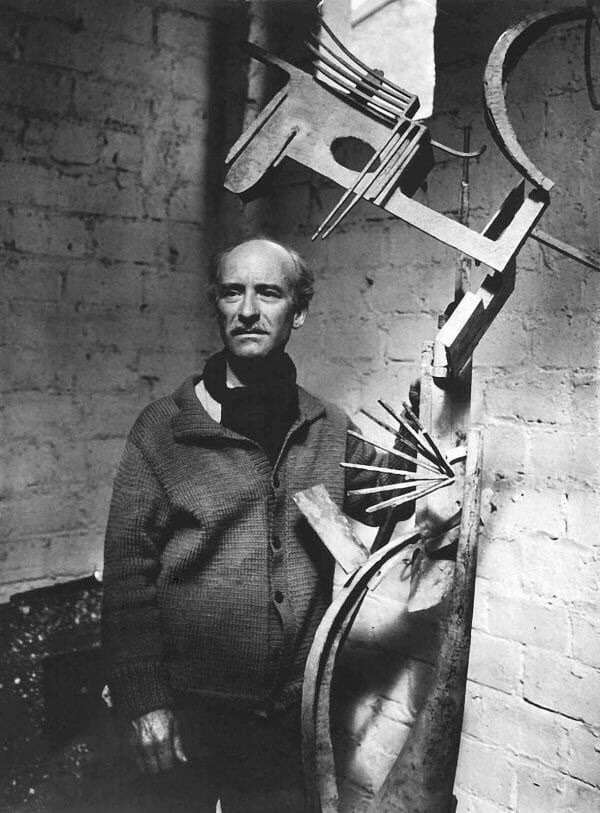
Julio González -
1900
Moving to Paris
After their father’s death, Joan and Julio sell the family business and the whole family settles in Montparnasse, where they meet up again with Picasso, Manolo Hugué, Pablo Gargallo, Joaquín Torres-García and Max Jacob.

Julio González, Self-portrait, c. 1900, graphite on paper -
1907
First exhibition in Paris
González exhibits in Paris for the first time, showing six paintings at the Salon des Indépendants.

Le Villars – The Blue Horizon, 1906-1907 -
1908
Death of Joan González
His brother Joan, always in fragile health, dies. Julio is devastated.

Joan González, Self-portrait, c. 1907-1908, blue crayon on paper, Musée d’Orsay -
1909
Birth of Roberta
He marries Louise “Jeanne” Berton, who had posed for him. Their daughter Roberta is born the same year; after the couple separates she grows up with her father and her aunts.
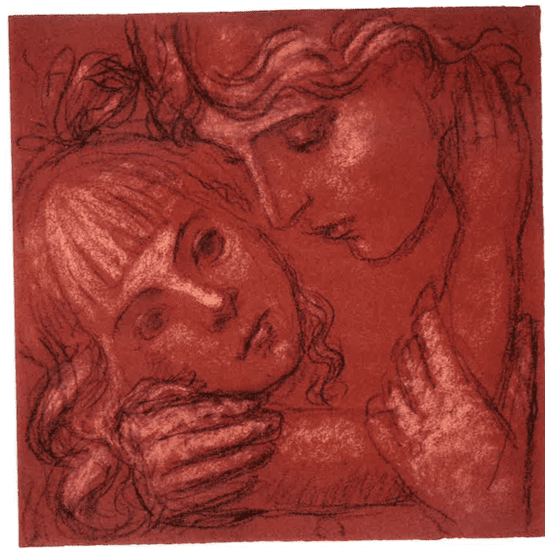
Roberta and Pilar, 1914 -
1911
Alexandre Mercereau, his agent
The writer and poet Alexandre Mercereau becomes his agent. González shows at several Paris salons, including the Salon d’Automne, and frequents the Closerie des Lilas with Modigliani and Brancusi.

Woman reading, 1906-1912 -
1912
First repoussé metal mask
He makes his first mask in repoussé metal, while continuing to paint, draw and make jewellery and metal objets d’art.

Frontal mask, 1912 -
1918
Oxyacetylene welding
In the factory where he works during the war, he learns oxyacetylene welding, a technique that will decisively shape his sculpture.

Seated woman, 1918 -
1922–1923
First solo exhibitions
First solo exhibition in March 1922 at the Povolozky gallery, well received by the press, followed by another in January 1923.
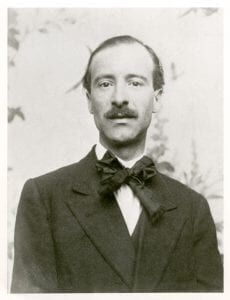
Anonymous, Julio González, c. 1920-1925 -
1928–1932
Collaboration with Picasso
González and Picasso work together on metal constructions designed for Guillaume Apollinaire’s funerary monument. The collaboration helps González assert his own sculptural language.
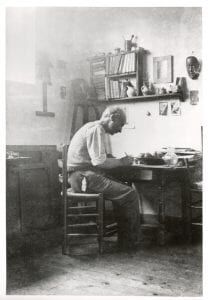
Julio González in his studio at Monthyon, 1928-1935 -
1929
Devoted to sculpture
He gives up painting to devote himself entirely to sculpture and signs a contract with the Galerie de France, where he first shows his iron sculpture in 1930.

Mask with cheekbone, 1929 -
1934
“The sculptor of the void”
“J. Gonzalez. Sculptures” at the galerie Percier (April–May); Maurice Raynal calls him “le plasticien du vide”. Another solo show at the Cahiers d’art gallery at the end of the year.

Dancer with a palette, 1934 -
1937
La Montserrat
La Montserrat, a determined Catalan peasant woman, holds a place of honour in the Spanish Republic’s Pavilion at the World’s Fair, alongside Guernica. Alfred Barr acquires the Head called “The Snail” for the Museum of Modern Art, New York.

La Montserrat, 1936-1937 -
1941
Back to Paris
Having taken refuge in the Lot with his family and his son-in-law Hans Hartung, González, unable to continue his iron sculpture there, returns to Paris and reconnects with Picasso and his Spanish friends.
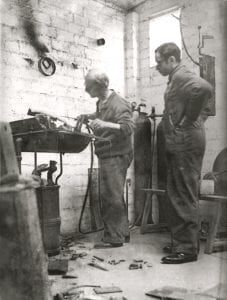
Julio González and Hans Hartung in the Arcueil studio, c. 1937-1939 -
1942
Death of Julio González
He dies suddenly on 27 March. Picasso, Apel·les Fenosa, Luis Fernández and Christian Zervos attend his funeral. His daughter Roberta will then devote herself to promoting his work.

Two faces, 1942