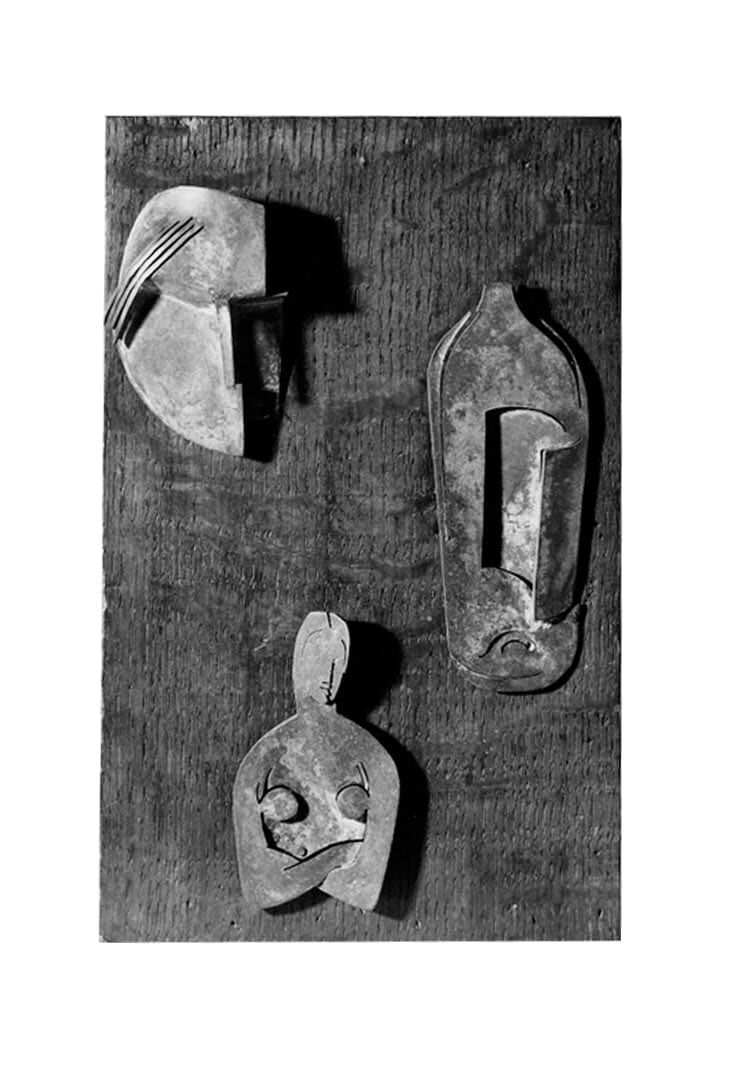
Masque my (mask my)
1927 -1929 · Sculptures
- Medium
- Iron, cast, welded, cut, bent
- Dimensions
- 14,8 x 8,4 x 3 cm
- Category
- Sculptures
A predilection for masks
González had a predilection for masks. In the 1920s, he creates an important group of masks in copper, using the repoussé technique. When he embraces iron sculpture at the end of this decade, his primary line of investigation is conducted through masks for two to three years. He creates different types of masks, articulated in one or two planes. Some have forms cut like intense shadows; Gonzalez calls these masks “in the sun”. Those composed of a succession of planes are called “heads in depth”. Masque My belongs to a group of masks composed of a single plane and sometimes realized with a sole sheet of iron. They are generally simple and lacking in detail. Five of them are signed and dated in 1930, the others are likely also from this same year, or a year before or after.
Modernity nourished by the art of African, pre-Columbian or Oceanic societies
The art of African, pre-Columbian or Oceanic societies, then in vogue among González’s avant-gardist circles, is a major source of inspiration for Masque My, and the development of modern art more broadly. These works, then referred to as “primitive”, were valued by artists seeking innovation, who considered them to be more direct, simple and emotionally charged forms of expression than traditional Western art, and fertile sources for artistic renewal. They are especially important to Picasso and Brancusi, two artists that González personally knew and admired. He had collaborated with Brancusi in the mid-1920s, and in 1930, he was in the midst of a close collaboration with Picasso begun in Autumn 1928.
Paris-based artists were able to discover this art from these civilizations in various ways. For example, in 1928, the anthropologist and museologist Georges-Henri Rivière organized the first of a series of exhibitions dedicated to African, pre-Columbian or Oceanic societies, in Paris’s Musée d’Ethnographie du Trocadero (Ethnographic Museum). Furthermore, the revue Cahiers d’Art, whose director Christian Zervos was a personal friend of Picasso and González’s, published various richly-illustrated articles about these art forms.
The title Masque My, known from González family legend, and likely stemming from the sculptor himself, can be equated with the term with “Fang mask” or “Senufo mask”, a reference to African culture. Nonetheless, there is no known society or culture called “My”; it is an imaginative invention of González’s.
From the same period